Semantics
Semantics deals with the meaning that signals, e.g. words, take on in our minds. Meaning does not arise from the signal alone; context and the expectations of the recipient also play a role. Therefore, there is no 1:1 correspondence between words and meanings (concepts). The structure of concepts has its own unique architecture, which differs significantly from the linguistic structure of language.
Selected articles from the topic «Semantics»

music, Semantics
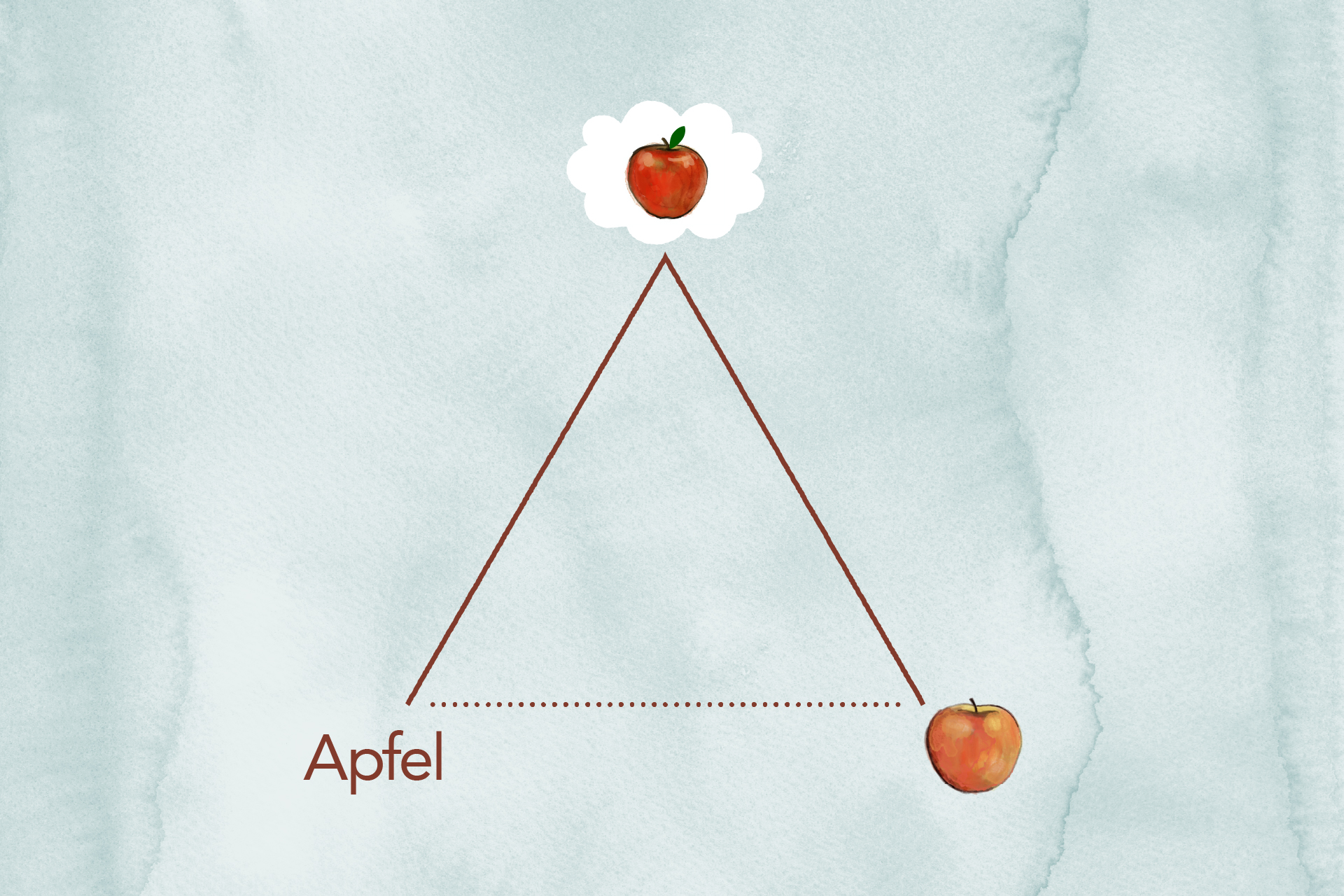
The semiotic triangle is a pattern that helps us to understand how our thoughts are connected with our languages and with the objects we mean with our words. These three worlds - thoughts, languages and objects - are represented by the three cornes of the semiotic triangle. Whenever we deal with words or meaning,
0 comments on The Semiotic Triangle20. September 2024

More articles and posts
Have you ever wondered why the musical scales in all musical cultures, whether in the jungle, in the concert hall or in
Paradoxes are contradictions in logic. Some can be solved inside the the logical system, while others resist this attempt. Some contradictions
25. February 2025 0 comments on Paradoxes and self-referenceSelf-reference plays a crucial but widely underestimated role in logic. Douglas Hofstadters 'Gödel-Escher-Bach' In the 1980s, I read Douglas Hofstadter's cult book
25. February 2025 0 comments on Self-reference 1Stanislaw Lem on entropy (littering) Littering in space had been a concern long before Elon Musk's Starlink programme, and various methods for
11. February 2025 0 comments on Ijon Tichy meets artificial IntelligenceOscillations: the physical basis of resonance Resonance is always based on the natural oscillations of two physical objects and their mutual coupling Coupling
13. November 2024 0 comments on What is Resonance?What energy is, appears evident to most of us. This is different with its counterpart entropy. Entropy, however, explains much of our
27. September 2024 0 comments on Entropy between Micro and Macro LevelThe semiotic triangle is a pattern that helps us to understand how our thoughts are connected with our languages and with
20. September 2024 0 comments on The Semiotic TriangleThe term entropy is often avoided because it contains a certain complexity that cannot be argued away. But when we talk about
11. September 2024 0 comments on Entropy and InformationDefinition of Entropy The term entropy is often avoided because it contains a certain complexity. The phenomenon entropy, however, is constitutive
4. September 2024 0 comments on What is Entropy?continues paradoxes and logic (part 2) History Before we Georg Spencer-Brown's (GSB's) distinction as basic element for logic, physics, biology and philosophy,
23. August 2024 0 comments on Georg Spencer-Browns Distinction and the BitIn logic there is a single basic pattern, found in every true paradox. The kernel of each true paradox consists of
22. August 2024 0 comments on Logic kernels in true paradoxesIt is a widely accepted believe that logic systems should be free of contradictions. In reality, however, we are always faced with
21. August 2024 0 comments on Logic and ParadoxesWhich of these preconceptions do you share? Entropy is for nerds Entropy is incomprehensible Entropy is thermodynamics Entropy is noise Entropy is
16. August 2024 0 comments on Five Preconceptions about EntropyLDC (Logodynamic cards) LDC is the new project of my team. It combines a digital slip box (Zettelkasten) for your personal collection
16. November 2023 0 comments on LDC – The logodynamic ZettelkastenWhat is the mental world? The mental world is the world in our heads. It is the way in which we perceive
28. March 2022 0 comments on The mental worldThe equal temperament has prevailed in our occidental music culture – despite the obvious shortcoming that its intervals are not pure any
When does resonance occur? Resonance between two physical media depends on the frequency ratio of their natural vibrations. When the two frequencies
22. February 2022 0 comments on Why resonance also works with imprecisionInitial wish: changing the fundamental tone during a piece of music In the preceding post, we saw that the just intonation is
14. February 2022 0 comments on The equal temperamentMusical scales before tempering Natural musical scales The musical scales of human cultures developed naturally, i.e. without any conscious mathematical considerations whatsoever,
1. February 2022 0 comments on How the tempered scales came into beingStarting point: two gaps In the previous post, we saw that in the sequence of the ten scales tones found so far, there are
27. December 2021 Off Comments off on Two Less Resonant Intervals for the GapsThe ten most resonant tones within the octave In this series of texts, we examine musical scales from the perspective of the
16. December 2021 Off Comments off on The Distribution of Tones within the OctaveThe Pythagorean comma The Pythagorean comma demonstrates that our tonal system is not perfectly consistent but has a gap whose form and
5. November 2021 Off Comments off on How does the pythagorean comma come about?The two diverging ideals of a theory Like every theory, the theory of music moves between two extremes. On the one hand,
24. July 2021 2 comments on Pure and impure temperamentThe major scale The major scale (Ionian mode) is the most widespread musical scale both in Europe and globally. It is a
As we have seen in the previous post, the tones C – D – E – G – A – C constitute
26. May 2021 0 comments on Standard pentatonic scalesSine waves play a crucial part for our considerations of resonance. On this page, I would like to explain the terms that
On this page, I will explain some rules which are applicable when we calculate with intervals and their frequencies. Intervals are fractions
Starting position Do the criteria which we have postulated so far already enable us to create musical scales which are so attractive that
29. April 2021 0 comments on First musical scalesWhat is this about? According to the theory of the three worlds, mathematics (ideal world) plays a part in physical processes (physical
Resonance works through shared overtones Resonance occurs when two vibratory physical objects vibrate together. What matters is the two objects’ natural frequency:
9. April 2021 0 comments on Fractions and ResonancesThe fifth Let us first have a look at the fifth. It is a feature of practically all the musical scales of
17. March 2021 0 comments on “Breaking down” the FifthWe find a huge variety of musical scales around the globe. The search for a common ground for the different scales
1. March 2021 Off Comments off on The overtone series is not a musical scaleThis is a post about the theory of the three worlds and continues the post about the perception of the octave. Does the coincidence of
9. February 2021 0 comments on Real Constraints for Musical ScalesThis is a post about the theory of the three worlds and continues the post about the resonance of the octave. The subjective side The
9. February 2021 0 comments on The Perception of the Octave in the Mental World"What you search is what you see" ist der Name eines Videospiels, entwickelt vom Japaner Akihiko Taniguchi, das die Macht der Suchmaschinen
30. January 2021 0 comments on What you search is what you seeThis is a post about the theory of the three worlds and continues the post about the octave. We generate a resonance If you regard
6. January 2021 0 comments on Resonance and OctaveA remarkable common feature All the musical scales known to me encompass an octave. Even scales which tones unusual to us Europeans
10. December 2020 0 comments on The OctaveThe bit is the basis of IT Our information technology is based on the bit. Everything that happens in our computers
29. November 2020 0 comments on The bit has no meaningScales are mathematical patterns When you hear a melody, it is based on a musical scale. The scale consist of the small
20. November 2020 0 comments on Musical Scales in the Theory of the Three WorldsThe world of the natural sciences The physical world is what is explored by the natural sciences and by physics in particular.
11. November 2020 0 comments on The Physical WorldWhy “Platonic”? Penrose calls one of the three worlds in the theory of three worlds as Platonic. Why? Plato The rich Athenian citizen Plato was
28. October 2020 2 comments on The Platonic worldWhat is semantics? A simple and easily understandable answer is that semantics is the meaning of signals. The signals can exist in any
13. October 2020 0 comments on Semantics and LinguisticsThe theory of the three worlds, according to Roger Penrose connects different fields of science and philosophy. The three worlds are: Die platonic
29. September 2020 0 comments on The theory of the three worldsThe theory of the three worlds There are practical questions which concern our specific lives, and there are theoretical questions which seemingly
28. September 2020 1 comment on The theory of the three worlds (Penrose)What is real intelligence? Paradoxically, the success of artificial intelligence helps us to identify essential conditions of real intelligence. If we accept
17. September 2020 0 comments on Artificial and natural intelligence: the differenceIn a nutshell: the intelligence is always located outside. a) Rule-based systems The rules and algorithms of these systems are created by
The dynamic IF-THEN differs from the static one by the fact that includes a time-span between IF and the THEN. The THEN
18. June 2020 0 comments on Static and dynamic IF-THEN, Part 2Go and chess The Asian game of Go shares many similarities with chess while being simpler and more sophisticated at the same
All the systems we have examined so far, including deep learning, can in essence be traced back to two methods: the rule-based
5. May 2020 0 comments on Overview of the AI systemsChess or jass: what requires more intelligence? (Jass is a very popular Swiss card game of the same family as whist and
27. April 2020 0 comments on Games and intelligence (1)AI can only see whatever is in the corpus Corpus-based systems are on the road to success. They are “disruptive”, i.e. they
22. April 2020 0 comments on How real is the probable?Two AI variants: rule-based and corpus-based The two AI variants mentioned in previous blog posts are still topical today, and they have
Two states at the same time In my last article I showed how a system can be described at two levels: that
Compiling the corpus In a previous post we saw how the corpus – the basis for the neural network of AI – is
In a preceding post we saw that in rule-based AI, intelligence is situated in the rules. These rules are drawn up by people,
Have the neural networks outpaced the rule-based systems? It cannot be ignored: corpus-based AI has overtaken rule-based AI by far. Neural networks
30. March 2020 0 comments on The three innovations of rule-based AIRule-based AI is lagging behind The distinction between rule-based AI and corpus-based AI makes sense in several respects since the two systems work
Rule-based in comparison with corpus-based Corpus-based AI (the “Tanks” type; cf. introductory AI post) successfully overcame its weaknesses (cf. preceding post). This
19. March 2020 1 comment on The challenges for rule-based AITwo AI variants: rule-based and corpus-based In the preceding post, I mentioned the two fundamental approaches to attempting to imbue computers with
19. March 2020 0 comments on Corpus-based AI overcomes its weaknessesAI in the last century AI is a big buzzword today but was already of interest to me in my field of
16. March 2020 0 comments on AI: Vodka and tanksCombinatorial explosion and information processing When we handle information we face combinatorial explosion everywhere. There is always more to know than
16. March 2020 0 comments on Combinatorial explosionExamples of information reduction In previous texts we looked at examples of information reduction in the following areas: Coding / classification Sensory
13. January 2020 0 comments on Information Reduction 7: Micro and Macro StateIs that physics? In my article Information reduction 5: The classic glass of water, I drew upon the example of a glass
12. January 2020 0 comments on Information Reduction 6: The Waterglass, RevisitedIt’s a commonly held belief that there’s nothing complicated about the idea of IF-THEN from the field of logic. However, I believe
2. December 2019 Off Comments off on IF-THEN: Static or Dynamic?An AI enters a bar. "What would you like to drink?" asks the bartender. "Hm - what do all the others take?"
1. September 2019 0 comments on Artificial Intelligence at the barIF-THEN and Time It’s a commonly held belief that there’s nothing complicated about the idea of IF-THEN from the field of logic.
8. July 2019 0 comments on Is ‘IF-THEN’ static or dynamic?Information reduction in thermodynamics A very specific example of information reduction can be found in the field of thermodynamics. What makes this
Framing matters The framing effect is a topic that comes up a lot these days. Framing is the phenomenon whereby the same
11. June 2019 0 comments on Information Reduction 4: FramingInformation reduction is everywhere In a previous post, I described how the coding of medical facts – a process that leads from
The funnel of information reduction In my previous article Information reduction 1, I described a chain of information processing from the patient
11. June 2019 0 comments on Information Reduction 2: The FunnelTwo types of coding In a previous post, I described two fundamentally different types of coding. In the first, the intention is
10. June 2019 0 comments on Information Reduction 1: CodingWhat does a bit mean? The question may seem trivial – after all, everyone knows that a bit represents a choice between
23. April 2019 0 comments on What information does a bit convey?