Unterkategorie Logik

Paradoxes and self-reference

Paradoxes are contradictions in logic. Some can be solved inside the the logical system, while others resist this attempt. Some contradictions are not solvable in principle, as K. F. Gödel proved hundred years ago. These true paradoxes all show the same formal kernel. The kernel contains typically a re-entry or self-reference. This phenomenon of re-entry or self-reference is at the core of all true paradoxes and a ticklish challenge for formal logic. Simple instruction for generating paradoxes The trick with which classical logical systems can be invalidated consists of two instructions: 1: A statement refers to itself. 2: The
Self-reference 1

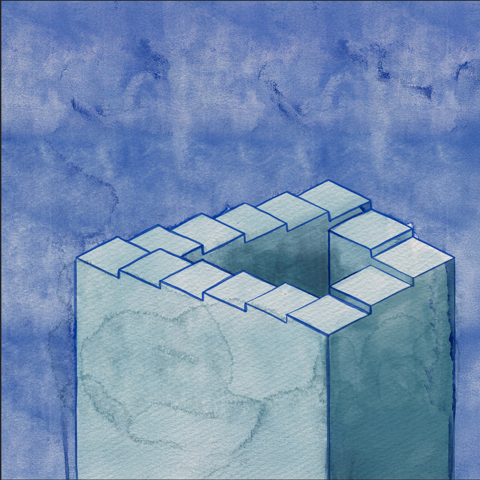
Self-reference plays a crucial but widely underestimated role in logic. Douglas Hofstadters 'Gödel-Escher-Bach' In the 1980s, I read Douglas Hofstadter's cult book ‘Gödel-Escher-Bach’ with fascination. Central to it is Gödel’s incompleteness theorem. This theorem shows the limit of classical mathematical logic. Gödel proved this limit in 1931 in conjunction with the fact that it is insurmountable for all classical mathematical systems as a matter of principle. This is quite astonishing! Is mathematics imperfect? As inheritors of the Age of Enlightenment and convinced disciples of rationality, we consider nothing to be more stable and certain than mathematics. Hofstadter's book impressed me. However, at certain

By |2025-12-25T16:05:39+00:0025. February 2025|Categories: Logic, Self-Referentiality|0 Comments
Go to Top