The Semiotic Triangle
The semiotic triangle is a pattern that helps us to understand how our thoughts are connected with our languages and with the objects we mean with our words. These three worlds – thoughts, languages and objects – are represented by the three cornes of the semiotic triangle.
Whenever we deal with words or meaning, it is essential to be aware that these three worlds are essentially different: Words are not the objects, nor are words identical with the concept in our thoughts. The form of the semiotic triangle helps us to distinguish the three worlds and is such our fundament as linguists, information scientists and writers.
Words and their Objects
When we speak, we use words to describe the objects in our environment. With words, however, we do not possess the objects, but only address them, and as we all know, words are not identical to the objects they describe. It is obvious that there is no identity.
But how does the relationship between words and objects look if it is not an identity? It cannot be a 1:1 relationship, because we use the same word to describe different objects. Conversely, we can use several words for the same object. The relationship is not fixed either, because the same word can mean something different depending on the context. Words change relentlessly over time, they change their sound and their meaning.
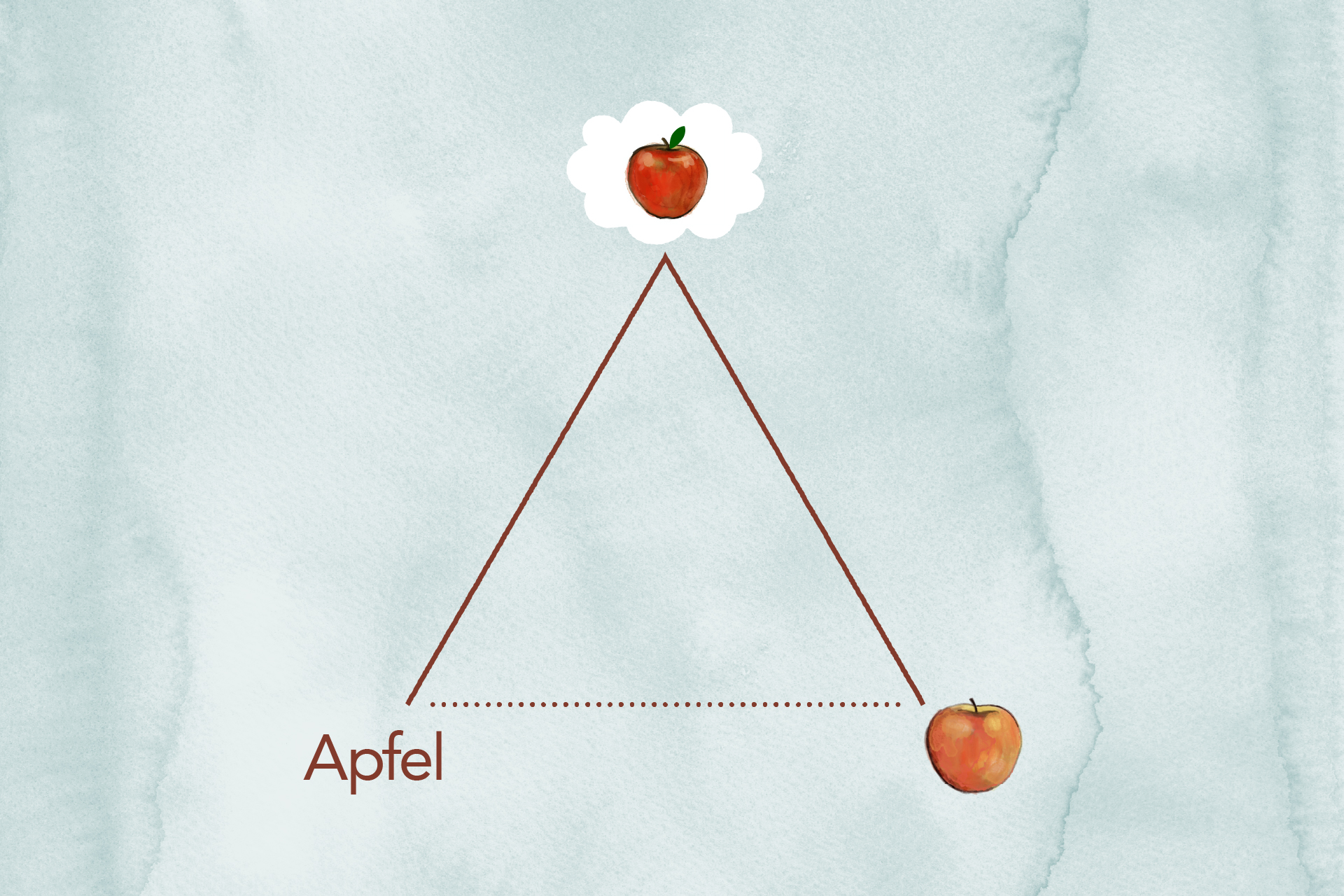
The relationship between words and designated objects is clearly illuminated by Ogden and Richards’1 famous depiction of the semiotic triangle from 1923.
The Semiotic Triangle

Fig 3: The semiotic triangle according to Ogden and Richards1
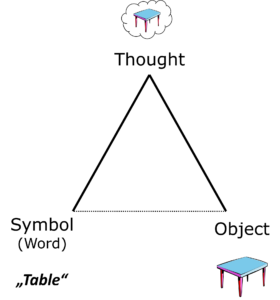
Fig 4: The semiotic triangle exemplified by the word ‘table’
The idea of the triangle has many predecessors, including Gottlob Frege, Charles Peirce, Ferdinand de Saussure and Aristotle.
Ogden and Richards use the semiotic triangle to emphasise that we should not confuse words, objects and concepts. The three points of the triangle point to three areas that are completely different in nature.
The tricky thing is that we are not just tempted but entirely justified in treating the three points as if they were identical. We want the word to describe an object precisely. We want our concepts to correspond exactly with the words we use for them. Nevertheless, the words are not the objects, nor are they concepts.
Ogden and Richards have this to say: «Between the symbol [word] and the referent [object] there is no other relevant relationship than the indirect one, which consists in the fact that the symbol is used by someone [subject] to represent a referent.»
Concepts in our heads
The relationship between the word (symbol, sign) and the object (referent) is always indirect and runs via someone’s thought, i.e. the word activates a mental concept in ‘someone’, i.e. a human subject, speaker or listener. This inside image is the concept.
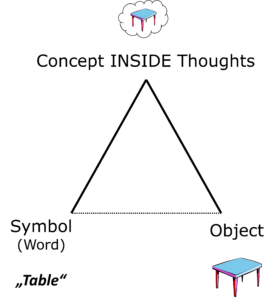
Fig. 5: This is how Ogden and Richards see the indirect relationship between symbol and indicated object (referent). The thoughts contain the concepts.
The diminished baseline in Fig. 5 can also be found in the original of 1923. Symbol (word) and referent (reference object) are only indirectly connected via the thoughts in the interpreting subjects. This is where the mental concepts are found. The concepts are the basic elements of our thoughts.
When we deal with semantics, it is essential to take a look at the triangle. Only the concepts in our heads connect the words with the objects. Any direct connection is an illusion.
This is a post on the topic of semantics.
Translation: Juan Utzinger
1 Ogden C.K. und Richards I.A. 1989 (1923): The Meaning of Meaning. Orlando: Harcourt.
Comments
Related Posts
Have you ever wondered why the musical scales in all musical cultures, whether in the jungle, in the concert hall or in the football stadium, span precisely an octave? Or
Paradoxes are contradictions in logic. Some can be solved inside the the logical system, while others resist this attempt. Some contradictions are not solvable in principle, as K. F.
Self-reference plays a crucial but widely underestimated role in logic. Douglas Hofstadters 'Gödel-Escher-Bach' In the 1980s, I read Douglas Hofstadter's cult book ‘Gödel-Escher-Bach’ with fascination. Central to it is Gödel’s
Stanislaw Lem on entropy (littering) Littering in space had been a concern long before Elon Musk's Starlink programme, and various methods for cleaning up the growing clutter in Earth's orbit