Expressions around waves and sine waves
Sine waves play a crucial part for our considerations of resonance. On this page, I would like to explain the terms that I use in this respect.
Wave
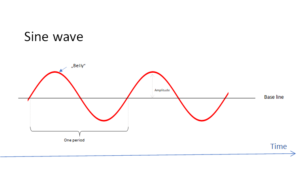
A wave is a motion in time which oscillates around a baseline.
A wave can have different shapes. For our considerations of resonance, we use pure sine waves; such a wave is shown in the graph above.
Amplitude
The amplitude is the deviation of a wave from the baseline. It does not play any primary role in our considerations.
Period
A period lasts as long as the wave takes to arrive in the same position to repeat itself again in precisely the same way. Depending on the shape of the wave, it crosses the baseline two or more times; in the case of the sine wave, it crosses it twice in opposite directions.
Wavelength
The wavelength is the length of a period.
Frequency
Frequency denotes the number periods per unit of time. It is the crucial value for our considerations of resonance, for whereas amplitudes and wavelengths change depending on the carrier medium of the wave, the frequency remains the same if the wave is transferred from one medium to another.
“Belly”
In each period, the sine wave has one belly in the positive direction and one belly in the negative direction. When we count the number of bellies per unit of time, we thus measure the frequency, i.e. counting bellies measures the frequency. This slangy expression has the advantage of being graphically illustrative. At the same time, the term “belly” emphasises indivisibility (mathematically: whole numbers!), whereas the frequency can be expressed in any real number.
With respect to resonance ratios, we always compare whole numbers, i.e. the number of completed bellies. Whether we only count the positive bellies or both the positive and the negative ones is irrelevant, since in a frequency comparison, only the relations of the frequencies matter.
Natural frequency
Certain physical media (strings, air columns in pipes, etc.) have the property of oscillating (vibrating) in a very specific frequency, their natural frequency.
Fundamental tone and overtones
Besides the natural frequency as the fundamental frequency (fundamental tone), the medium can also oscillate with a multiple integer of the fundamental frequency. Multiple integer means that the crucial factor is the number of whole periods (bellies).
Comments
Related Posts
Have you ever wondered why the musical scales in all musical cultures, whether in the jungle, in the concert hall or in the football stadium, span precisely an octave? Or
Paradoxes are contradictions in logic. Some can be solved inside the the logical system, while others resist this attempt. Some contradictions are not solvable in principle, as K. F.
Self-reference plays a crucial but widely underestimated role in logic. Douglas Hofstadters 'Gödel-Escher-Bach' In the 1980s, I read Douglas Hofstadter's cult book ‘Gödel-Escher-Bach’ with fascination. Central to it is Gödel’s
Stanislaw Lem on entropy (littering) Littering in space had been a concern long before Elon Musk's Starlink programme, and various methods for cleaning up the growing clutter in Earth's orbit