The Semiotic Triangle

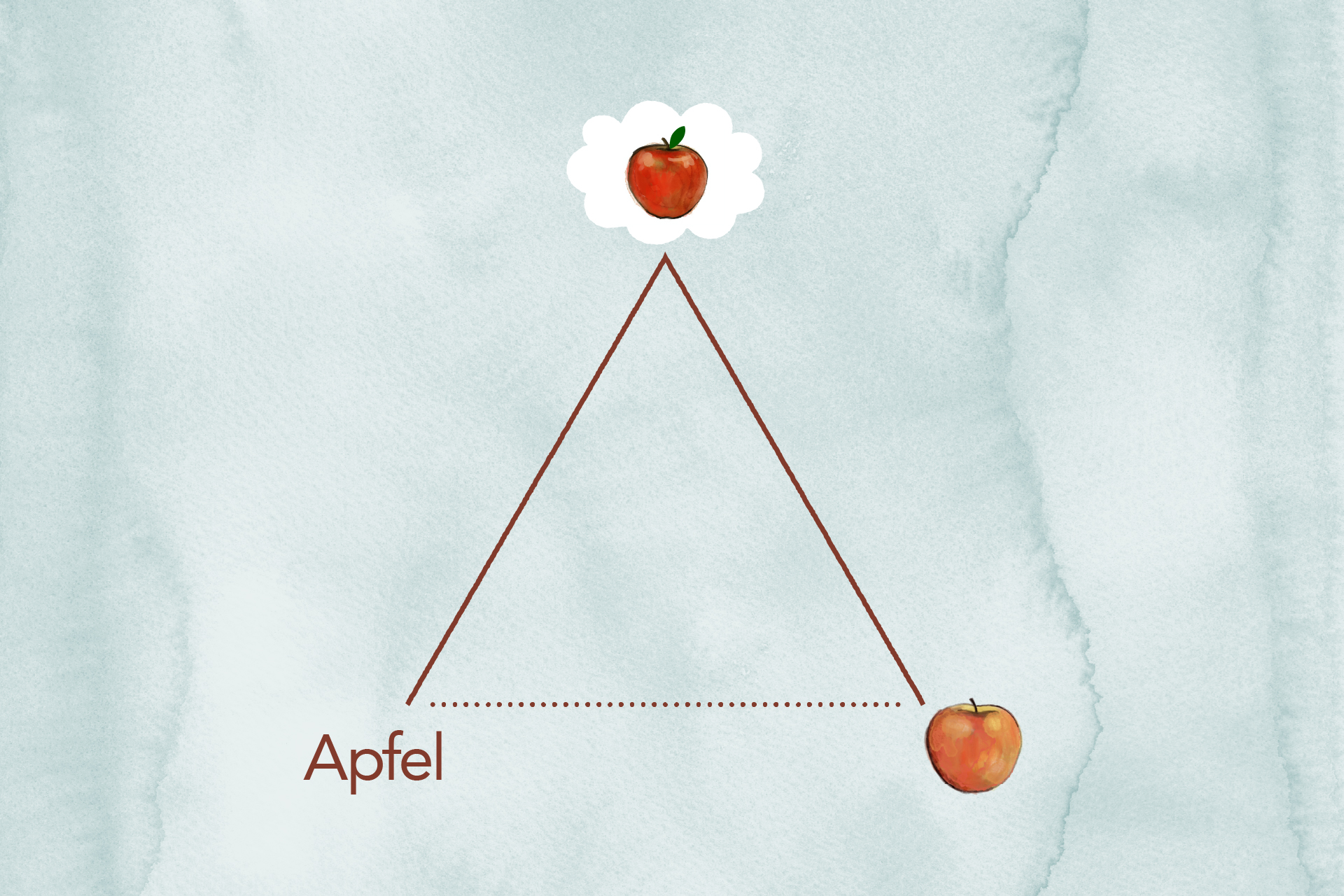
Words and their Objects When we speak, we use words to describe the objects in our environment. With words, however, we do not possess the objects, but only describe them, and as we all know, words are not identical to the objects they describe. It is obvious that there is no identity. Some funny examples of the not always logical use of words can be found in the following text (in German), which explains why the quiet plays loudly and the loud plays quietly. Fig 1: The piano (the quiet one) Fig. 2: The lute (the wood) But how does the


By |2025-12-03T14:49:07+00:0020. September 2024|Categories: music, Semantics|Tags: , , , , |0 Comments

The mental world

What is the mental world? The mental world is the world in our heads. It is the way in which we perceive the world; it consists of our sensations, feelings and thoughts. It is a completely subjective world. In the theory of the three worlds, the mental world is the third world besides the physical and the Platonic worlds. Difference from the physical world Whereas the physical world is objectively comprehensible, the mental world remains subjective. In other words: whereas we can observe the objects of the physical world from the outside, this is impossible with the objects of the

The bit has no meaning

The bit is the basis of IT Our information technology is based on the bit. Everything that happens in our computers is based on this smallest basic element of information. If someone asks you what a single bit means, you may well answer that the bit can assume two states, of which one means 0 and the other means 1. As is generally known, this enables us to write numbers of any size; all we have to do is to line up a sufficient number of bits. But is this really true? Does the one state in the bit really

By |2025-11-15T13:17:19+00:0029. November 2020|Categories: Information, Semantics|0 Comments

Semantics and Linguistics

What is semantics? A simple and easily understandable answer is that semantics is the meaning of signals. The signals can exist in any form: as text, as an image, etc. The most frequently studied semantics is that of words. This is a good reason to examine the relationship of linguistics and semantics. Can semantics be regarded as a subdiscipline of linguistics? Linguistics and semantics Linguistics, the science of language and languages, has always examined the structure (grammar, syntax) of languages. Once the syntax of a sentence has been understood, linguists see two further tasks, i.e. secondly to examine the semantics of

By |2025-11-12T10:51:35+00:0013. October 2020|Categories: Semantics|Tags: , , , , |0 Comments

What Information does a Bit convey?

What does a bit mean? The question may seem trivial – after all, everyone knows that a bit represents a choice between 0 and 1. Isn't it? So, what’s the problem? The problem is that 0 and 1 are not the only answers. 0 and 1 are just a pair of possible instantiations for a bit, especially useful if you look at numbers, but there are many more possiblities. Classic examples are: – yes and no - true and false - positive and negative - on and off to name but a few. Other options include male/female, inside/outside, good/bad and

By |2025-12-03T15:11:48+00:0023. April 2019|Categories: Information, Semantics, Bits|0 Comments
Go to Top