The Semiotic Triangle

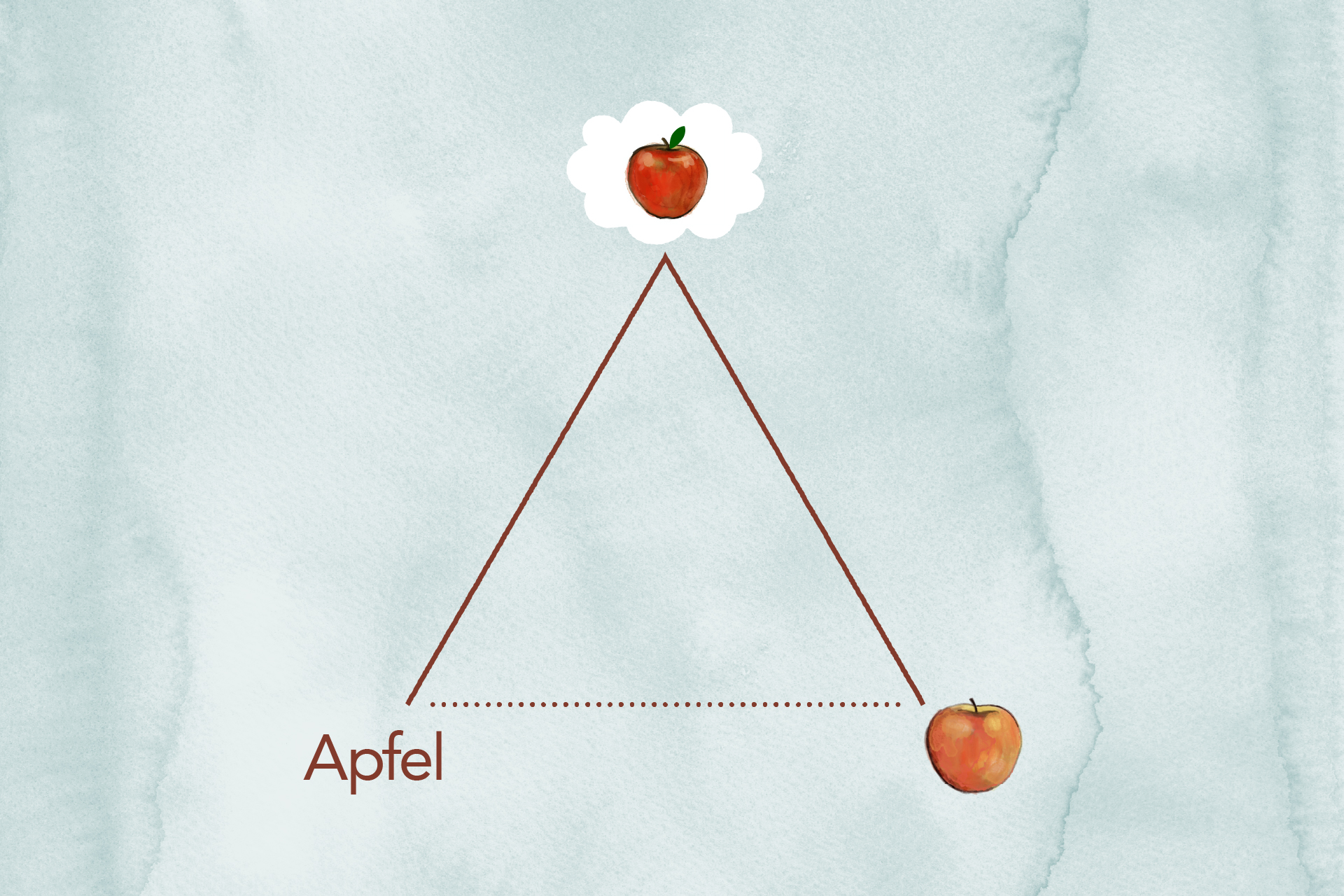
Words and their Objects When we speak, we use words to describe the objects in our environment. With words, however, we do not possess the objects, but only describe them, and as we all know, words are not identical to the objects they describe. It is obvious that there is no identity. Some funny examples of the not always logical use of words can be found in the following text (in German), which explains why the quiet plays loudly and the loud plays quietly. Fig 1: The piano (the quiet one) Fig. 2: The lute (the wood) But how does the


By |2025-12-03T14:49:07+00:0020. September 2024|Categories: music, Semantics|Tags: , , , , |0 Comments

Semantics and Linguistics

What is semantics? A simple and easily understandable answer is that semantics is the meaning of signals. The signals can exist in any form: as text, as an image, etc. The most frequently studied semantics is that of words. This is a good reason to examine the relationship of linguistics and semantics. Can semantics be regarded as a subdiscipline of linguistics? Linguistics and semantics Linguistics, the science of language and languages, has always examined the structure (grammar, syntax) of languages. Once the syntax of a sentence has been understood, linguists see two further tasks, i.e. secondly to examine the semantics of

By |2025-11-12T10:51:35+00:0013. October 2020|Categories: Semantics|Tags: , , , , |0 Comments

The three innovations of rule-based AI

Have the neural networks outpaced the rule-based systems? It cannot be ignored: corpus-based AI has overtaken rule-based AI by far. Neural networks are making the running wherever we look. Is the competition dozing? Or are rule-based systems simply incapable of yielding equivalent results to those of neural networks? My answer is that both methods are predisposed for performing very different functions as a matter of principle. A look at their respective modes of action makes clear what the two methods can usefully be employed for. Depending on the problem to be tackled, one or the other has an advantage. Yet

Go to Top